2 main areas when media effects are discussed:
Theories that can be applied to each area:
Give an example of a media text that caused a 'moral panic'.
BBFC:
They give age rating o films.
To 'protect' the public from violen or inappropriate content.
Used o be called British Board of Film Censors...changed its name in 1984.
From the early 80s, home videos emerged (VHS), BBFC realised that they can not control what people watch at home.
Video Recording Act 1984.
The video recording act came about due too 'video nasties'. The people wanted to watch incredibly gory content, because they couldn't watch them at the cinema, so they bought the films instead. Films were not rated at the time. Even though they do not block films, they still sometimes need to ask the producer to cut out certain scenes, in order to give them an 18 rating.
5 examples of content from my film that support or go agains t he regulatory guidelines for the age classification.
Wednesday, 16 November 2016

Tuesday, 15 November 2016
LO6: Media Effects
https://www.theguardian.com/politics/2008/aug/05/politicsandthearts
-Dark Themes
-Mental Healh
-Psychopathic
-Sadistic
Do I agree with the article?
a) PASSIVE AUDIENCE THEORY
Hypodermic syringe - implies that media has a negatice impact. Mass audience believe everyhing they/hear (Adorno and Horkheimer).
In the 1940-50's, the mass media were percieved as an extreme influence towards audiences adapted behaviour. This was linked to rise of advertising and consumerism.
This model does not hold much positivity for the audience, however it is a good method for a meia producer, politicians and also towards the use of marketing.
In 1975 Vance Packard looked at the relationship between advertising and media effects in his book the 'Hidden Persuaders'.
He believed the media were condiioning people o want products and services with the rise of consumerism.
When the 'mass media' demonise groups, people or products they beleive become a threat to society, values and inerests it is called a 'moral panic' (Stanley Cohen, 1972).
The group/products are referred to as 'folk devils'.
Violence in the media
Anderson (2007) that high exposure to fast-paced violent games can lead to changes in brain function when processing violent images, incluing dapening of emotional resposes to violence. One of the high risk factors?
This is known as desensitisation.
Ferguson (2012) showed no long term link over three years.
Three media products that have ben critiised for being too violentnegatie impact.
Copycat violence.
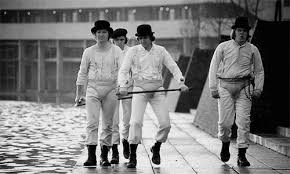
1. A clockwork orange.
This film features a scene when a gang rapes a woman, while singing "singing in the rain" inspired a real-life gang rape where they sang singing in the rain. There was also a man who dressed as droog who assaulted a woman.
-Dark Themes
-Mental Healh
-Psychopathic
-Sadistic
Do I agree with the article?
a) PASSIVE AUDIENCE THEORY
Hypodermic syringe - implies that media has a negatice impact. Mass audience believe everyhing they/hear (Adorno and Horkheimer).
In the 1940-50's, the mass media were percieved as an extreme influence towards audiences adapted behaviour. This was linked to rise of advertising and consumerism.
This model does not hold much positivity for the audience, however it is a good method for a meia producer, politicians and also towards the use of marketing.
In 1975 Vance Packard looked at the relationship between advertising and media effects in his book the 'Hidden Persuaders'.
He believed the media were condiioning people o want products and services with the rise of consumerism.
When the 'mass media' demonise groups, people or products they beleive become a threat to society, values and inerests it is called a 'moral panic' (Stanley Cohen, 1972).
The group/products are referred to as 'folk devils'.
Violence in the media
Anderson (2007) that high exposure to fast-paced violent games can lead to changes in brain function when processing violent images, incluing dapening of emotional resposes to violence. One of the high risk factors?
This is known as desensitisation.
Ferguson (2012) showed no long term link over three years.
Three media products that have ben critiised for being too violentnegatie impact.
Copycat violence.
1. A clockwork orange.
This film features a scene when a gang rapes a woman, while singing "singing in the rain" inspired a real-life gang rape where they sang singing in the rain. There was also a man who dressed as droog who assaulted a woman.
2. Grand Theft Auto IV
3. Marlyn Manson
Representation
Who is being represented
All representations are mediated (Hall, 1980).
Is there use of stereotypes/countertypes (Perkins, 1979). Not all steriotypes are negative.
Represntaion of woman - are they objectified (Mulvey, 1975). Representation of men (Earp and Katz, 1999) - 'equation of masculinity with pathological control and violence'.
Represenation of gay poeple (Butler, 1993) - are they steriotypical.
Alvardo (1987), Hall (1995) - ethnicity 'exotic, dangerous, humorous, pitied'.
Turton (2014) - hooligans, trouble causers. Teenage, Black and Asian boys.
Lloyd (1995) girls as 'double deviant' - trouble causers bu shouuldn't be because they are 'women'
X-Men: DOFP Critisms, violence
Jeniffers lawrences body.
b.) ACTIVE AUDIENCE THEORY
Other school of thought - we are able to filter and adapt to onent in media (Gauntlett, 1995) - backwards...
We have uses and gratification (McQuail, 1972) theory - people use media for their own purposes?
Provides a more positive outlook on the effects of media.
Hall (1980) encoding / decoding model.
Preferred reading - by audience depending on their background but accepts the dominant viewpoint/story.
Negoitiated reading - partially agrees with meaning
Oppositional reading - meaning understood but don't agree and think opposite.
Aberrant - gets the completely wrong meaning entirely.
Positive effecs of X-Men: DOFP?
What can it be used for? Any messages?
Identiy the potential impact of a media product you have studied on the audience
X-Men: DOFP Critisms, violence
Jeniffers lawrences body.
b.) ACTIVE AUDIENCE THEORY
Other school of thought - we are able to filter and adapt to onent in media (Gauntlett, 1995) - backwards...
We have uses and gratification (McQuail, 1972) theory - people use media for their own purposes?
Provides a more positive outlook on the effects of media.
Hall (1980) encoding / decoding model.
Preferred reading - by audience depending on their background but accepts the dominant viewpoint/story.
Negoitiated reading - partially agrees with meaning
Oppositional reading - meaning understood but don't agree and think opposite.
Aberrant - gets the completely wrong meaning entirely.
Positive effecs of X-Men: DOFP?
What can it be used for? Any messages?
Identiy the potential impact of a media product you have studied on the audience
Wednesday, 9 November 2016
LO4 Uses and Gratifications theory
(Denis McQual, 1972)
- There are four reasons that people consume media products/pleasures they gain from them:
1. Surveillance - using the media to find out information, social media, the news, radio.
2. Escapism - people who prefer the different reality within media, as oppose to the reality we live in.
3. Building personal identitiy - using media products to build your personality, people use characters in media to be role models
4. Building personal realtionships - using media to connect to people (social) provides a topic of conversation
Using the examples you have from the film, apply the 'uses and gratifications' theory to the work.
(Example: "Four Lions offers the gratification survellance about the current political climate and information about the belief of different cultures because...")
X-Men: Days of Future Past offers Escapism, due to the world being based in the Mutant Universe, where mutants live among human beings, which is highly unrealistic, it also offers surveillance, since it offers a social commentry on discrimination. It also offers th ALL 4
Narrative resolution? (all)
Freudenschade? (comedy) Laughing at other people, harm joy.
Stars? (Dyer, 1975) (all)
Freindship/companionship? (all)
Target audience for X-men days of future past
Gender: I think the gender split would be 70:30 (male:female) since the main characters
Audience Theory
John Hartley 1987 - all media products have 'Invisible fictions' before they are made.
Ien Ang 1991 - all media producers have 'imaginary entities' in mind before thir production.
Before a production is made, media companys make up 'imaginary entities' who they think will be buying their product.
Ien Ang 1991 - all media producers have 'imaginary entities' in mind before thir production.
Before a production is made, media companys make up 'imaginary entities' who they think will be buying their product.
Key words
Demographic - Charecteristics of audiences.
Conglemerate - Large media company which owns subsidiaries.
Horizontal Integration - Where a comglemarate can market a media product through it's subsidiaries across different sectors.
Audience - The people media companies want to buy their products
Independent - Media company that is not owned by conglemarate.
Niche - Specific small demographic.
Mass - a large target audience.
Conglemerate - Large media company which owns subsidiaries.
Horizontal Integration - Where a comglemarate can market a media product through it's subsidiaries across different sectors.
Audience - The people media companies want to buy their products
Independent - Media company that is not owned by conglemarate.
Niche - Specific small demographic.
Mass - a large target audience.
Tuesday, 8 November 2016
LO4 Undersand the target audienceof media
Audince reseach is when a company gathers infomation on certain audiecences in order to make their product appeal to the audience.
NRS (National Readership Survey)
They collect audience research for print and adverising trading in Britain.
The NRS collect DATA through groupin audiecnes through age, genre, etc
Upper Middle Class, Middle Class and Lower Middle Class all have a lot of disposable income.
BARB (Broadcast Audience Research Board)
Is responsable fo delivering he Unied Kingdom's Television audience measurement systems
The cover 5 questions when conducting and collecting audience research data:
1. Who is watching?
2. What are they watching?
3. When are they watching it?
4. Which screen are they watching it on?
5. How did the content get to the screen?
Primary Research
Questionairres
Surveys
Interviews
NRS (National Readership Survey)
They collect audience research for print and adverising trading in Britain.
The NRS collect DATA through groupin audiecnes through age, genre, etc
Upper Middle Class, Middle Class and Lower Middle Class all have a lot of disposable income.
BARB (Broadcast Audience Research Board)
Is responsable fo delivering he Unied Kingdom's Television audience measurement systems
The cover 5 questions when conducting and collecting audience research data:
1. Who is watching?
2. What are they watching?
3. When are they watching it?
4. Which screen are they watching it on?
5. How did the content get to the screen?
Primary Research
Questionairres
Surveys
Interviews
Tuesday, 1 November 2016
LO3 Theories of representation
1. Name one theorist that discusses gender representation that you have looked at so far in Unit 1, Unit 3 or GCSE.
3. Give an example from a media text to support or challenge the above theory.
How the media shows us things about society - but this is through careful mediation.
Hence re-presentation.
Mini - plenary!
To show your understanding of representation - write down briefly the main story or plot of your film.
Narrative or X-Men: Days of Future Past
In the future Robot Assassins are sent to wipe out the mutants, so they send wolverine back in time to go and stop the robots from ever being created.
The view of reality in X-Men: DOFP time travel is possible, mutants exist and have powers
Key theory 3: Laura Mulvey (1975)
Male gaze. Women are objectified in media texts and passive objects.
Audiences are positioned to view the women from the point of view of a heterosexual male.
For example in X-Men: Days of future past the Character Mystique's costume, shows her body in detail in a sexual way. She is objectified.
Key theory 4: Stuart Hall 1995
Western/white cultured continue to misrepresent ethnic minorities as in the media due to underlying racist tendencies.
non-white as 'the other', evil, barbaric.
Edward Said 1987
Black people in films are usually pitied, humorous, exotic, danger.
John Berger 1972
3. Give an example from a media text to support or challenge the above theory.
How the media shows us things about society - but this is through careful mediation.
Hence re-presentation.
Mini - plenary!
To show your understanding of representation - write down briefly the main story or plot of your film.
Narrative or X-Men: Days of Future Past
In the future Robot Assassins are sent to wipe out the mutants, so they send wolverine back in time to go and stop the robots from ever being created.
The view of reality in X-Men: DOFP time travel is possible, mutants exist and have powers
Key theory 3: Laura Mulvey (1975)
Male gaze. Women are objectified in media texts and passive objects.
Audiences are positioned to view the women from the point of view of a heterosexual male.
For example in X-Men: Days of future past the Character Mystique's costume, shows her body in detail in a sexual way. She is objectified.
Key theory 4: Stuart Hall 1995
Western/white cultured continue to misrepresent ethnic minorities as in the media due to underlying racist tendencies.
non-white as 'the other', evil, barbaric.
Edward Said 1987
Black people in films are usually pitied, humorous, exotic, danger.
John Berger 1972
Subscribe to:
Posts (Atom)